The Nepean end
Sorrento was opened for housing in 1869, the Continental Hotel went up in 1875, and the town's older buildings are limestone, according to the published history; its 2021 population was 2,013. Portsea's Back Beach Road precinct, in the Shire's own heritage citation, holds houses from the 1870s to the 1950s: limestone villas, timber cottages and bungalows, with fibro-cement in the inter-war bungalows. Blairgowrie fills in between with the post-war holiday houses the Shire's thematic history describes. What the three towns share is absence. The Shire's Open Space Strategy puts dwellings empty on census night 2021 at 63.9 per cent for Portsea, Sorrento and Blairgowrie, the highest in the Shire. A house here is more likely than anywhere on the Peninsula to be visited a few weekends a year, and its stumps more likely to have been going quietly for a decade.
The work is reblocking timber cottages and bungalows on stumps that have leaned or sunk in sand, replacing the few stumps that have gone under a sleep-out or a verandah, and bearer and joist work under houses that have been shut up with the vents blocked. Less of it is underpinning, though the limestone villas on strip footings are the exception and the engineer's.
The age of the stock matters in one more way. A cottage that has stood since the 1880s has usually been restumped at least once, and the stumps under it now may be the second or third set, put in at different times by different hands, some with a permit and some without. The inspection finds a mix: an old redgum stump beside a 1970s concrete one beside a stack of packing, and the quote has to count each kind. For a buyer at the Nepean end, asking the vendor for whatever paperwork exists from past work is the first question, and the buying guide explains what to do when the answer is a shrug.
The ground: the Cups dunefield
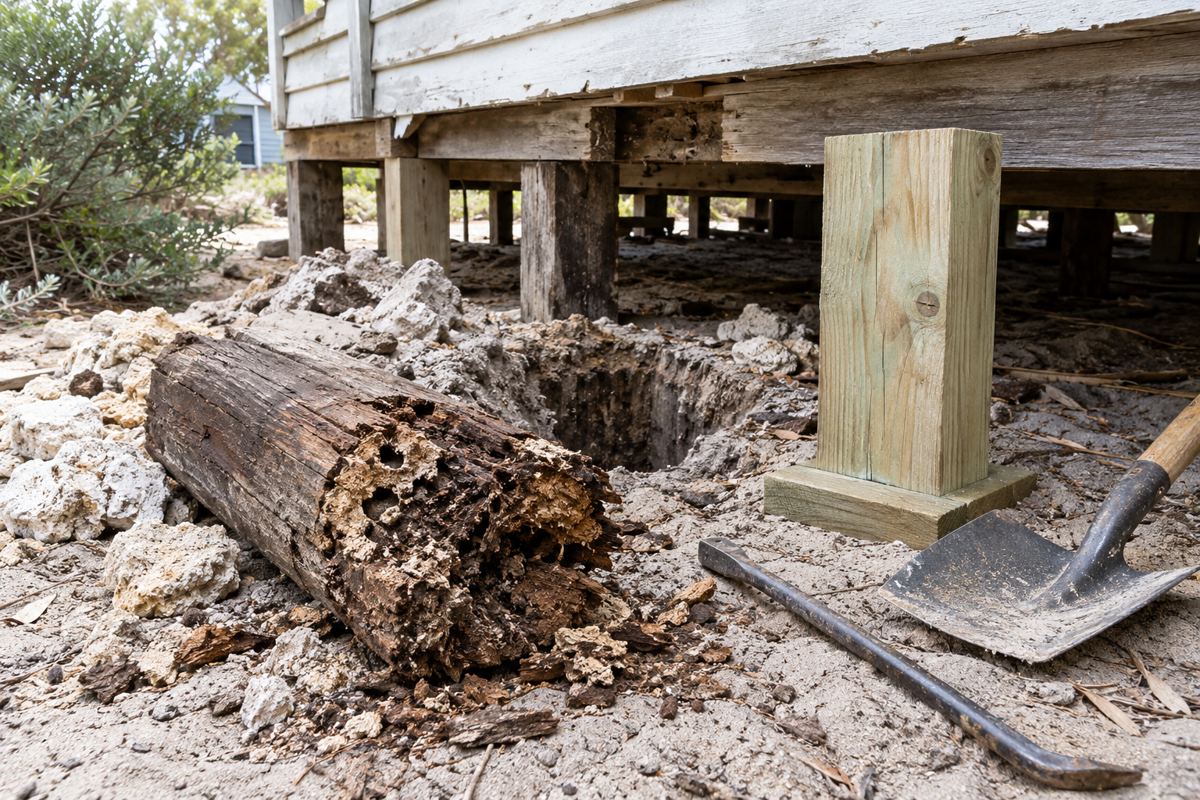
Victorian Resources Online maps the Nepean peninsula west of Truemans Road as the Cups unit: a dunefield of deep grey calcareous sand with a pH of 8 to 8.5. Three things follow for a house. The sand drains, so a timber stump here is not standing in winter water the way one in Hastings is, and old stumps on the Nepean end are often sound in the timber and wrong in the position. The sand has no strength of its own, so a stump set shallow leans when the ground beside it is dug, washed or walked on, and a hole dug for a new stump wants to fall in and has to be shored. And the sand is alkaline and salt-laden near both coasts, which is hard on unprotected steel and worth knowing when choosing between galvanised steel on a base plate and precast concrete. The limestone that the old villas were built from shows up as rubble in the sand and as rock close to the surface on the ridge, which on some blocks is the firm layer a stump can stand on. The Bureau of Meteorology's Cerberus station averages 712.8 mm a year, winter-wet and summer-dry; on sand that means a dry subfloor most of the year and a rush of water through the dunes when it rains, which is when loose sand moves. The soils guide goes through it.
Heritage: the precincts and what they mean under the floor
This is the part of the Peninsula where the planning scheme most often reaches a restump. The Sorrento Historic Precinct HO1 covers the town in four parts: HO1A commercial, HO1B foreshore, HO1C clifftop and HO1D residential. The East Sorrento Precinct is HO488 and the Back Beach Road Portsea Precinct is HO470. Amendment C262morn, approved in November 2021 and May 2022, added 65 individual places and six precincts across Blairgowrie, Sorrento and Portsea. The Continental Hotel is on the Victorian Heritage Register as H1896, and any registered place needs Heritage Victoria's approval separately from the Shire.
| Heritage control | Where | What it means for a restump |
|---|---|---|
| HO1A to HO1D, Sorrento Historic Precinct | Sorrento commercial centre, foreshore, clifftop and residential areas | Planning permit for external alterations and for repairs not to the same details and materials. Like-for-like restumping below the floor is arguably maintenance; a raised floor or new base line is not. Ask heritage@mornpen.vic.gov.au first. |
| HO488 East Sorrento Precinct | East Sorrento | As above. |
| HO470 Back Beach Road Portsea Precinct | Back Beach Road, Portsea | Houses 1870s to 1950s, limestone villas, timber cottages and bungalows. As above, with the limestone villas more likely to be underpinning on strip footings than restumping. |
| C262morn places and precincts | Blairgowrie, Sorrento and Portsea, 65 places and six precincts | As above; check the state planning map for the lot. |
| Victorian Heritage Register | Continental Hotel H1896 and any other registered place | Heritage Victoria's approval, separate from the Shire. |
The Shire's Heritage Overlay page does not mention restumping, and this site does not say the work needs no permit or that it does. The position is that like-for-like stumps that leave the outside and the floor level unchanged are arguably maintenance; that raising a cottage for clearance, cladding the gap or changing the base line is a visible change that can trigger a permit; and that the Shire's free pre-application heritage advice is the first call, before the surveyor and before the quote. The overlays page has the full position.
What a Nepean end job usually looks like
- A timber cottage in HO1D or HO470. Stumps that have leaned or sunk in sand, a verandah on its own shallow stumps that went first, a floor that slopes toward the garden side. Heritage advice first, then a like-for-like restump in concrete or steel at the same floor level, bearers replaced where the shut-up subfloor got to them.
- An inter-war bungalow with fibro-cement cladding. Often low to the ground. Every hole dug by hand through a hatch, holes shored in loose sand, stumps set on a base that spreads the load. The cost guide explains why clearance moves the price here more than anything.
- A post-war holiday house in Blairgowrie. Weatherboard or fibro on stumps, shut up for most of the year, vents blocked with tea-tree litter. Inspection first, a pest inspection on the same visit, then full or partial restump depending on the count.
- A limestone villa on strip footings. Not a restump. Cracking in limestone over a footing that has moved in sand is underpinning on an engineer's design, with the heritage team and possibly Heritage Victoria involved before the engineer.
- A clifftop house at Portsea or on the back beach dunes. Slope, sand and EMO7. The engineer and the planner before the restumper.
EMO7, bushfire and the rest
Blairgowrie and Portsea are both field inspection areas under Amendment C314morn, approved 19 October 2026, which narrowed the interim EMO7 landslide overlay from about 33,000 properties to about 6,000 after the McCrae landslide of January 2025. On the clifftop and the back beach dunes, building and earthworks may need a planning permit and a landslide risk assessment by a qualified engineer or geologist; the Shire waives its fees where EMO7 is the sole trigger and no risk is apparent. Ask the Shire whether a sloping lot is still in EMO7 after C314morn. Much of the Nepean end sits in or beside bush and foreshore reserve, and in a Bushfire Prone Area alterations and additions must meet AS 3959 with the BAL assessed at building permit stage; a restump alone rarely changes anything, but the surveyor says whether the subfloor is affected. The whole Shire is designated subject to termite infestation, and a cottage that stands empty from Easter to Christmas with tea-tree litter against its base is exactly the house a pest inspection should visit at the same time as the restumper.
The rules, and the absent owner
Everything else is the same as the rest of the Peninsula: a building permit from a private registered building surveyor, because the Shire does not issue them; a builder registered with the Building and Plumbing Commission at any job value; a written major domestic building contract over $10,000; Home Warranty insurance over $20,000 from 1 July 2026; a property information certificate (regulation 51(2), $53.62 in 2025-26) if you want the flood and termite designations in writing. The permits page lays it out. What the Nepean end adds is logistics. Most owners are in Melbourne. The agent holds the key, the neighbour makes the call about the back step, and the job is best run in spring with the house empty, the road quiet and a block that can be opened up for a week before the summer crowd. For a buyer, the buying guide covers what to ask for when the vendor has not been under the floor in years.
What cannot be fixed at the end of the Peninsula
The sand. It will move when disturbed whatever the stump is made of; the base is the job, and a stump set on loose sand is a stump set twice. The heritage question. A page cannot tell you whether the Shire's heritage team will treat a particular restump in HO1D or HO470 as maintenance; the free pre-application advice can, and it comes before the quote. The overlay. Whether a clifftop lot at Portsea or a back beach block at Blairgowrie is still in EMO7 after C314morn is the Shire's answer. And the absence: a house visited three weekends a year cannot be watched from Melbourne, which is why the inspection matters more here than anywhere.
Check the current rules before you rely on this
This page describes restumping on the dune sand and under the heritage precincts of Sorrento, Portsea and Blairgowrie at the Nepean end of the Mornington Peninsula. It describes the rules in general terms as they stood in October 2026. Standards, forms, thresholds and fines change.
The authoritative sources are Wikipedia, Sorrento, Victoria, Heritage review citation, Back Beach Road Portsea precinct, Mornington Peninsula Shire open space strategy, housing and occupancy, Victorian Resources Online, Cups soil unit, Mornington Peninsula Shire, Amendment C262morn heritage review (Blairgowrie, Sorrento, Portsea), Mornington Peninsula Shire, Heritage Overlay and planning permits and Victorian Heritage Database, Continental Hotel Sorrento. Where anything here differs from those sources, they are right and we are not.
We are not building surveyors, engineers, planners or lawyers. For what applies to your house, ask a registered building surveyor or ring Mornington Peninsula Shire on 1300 850 600.
Accurate at the time of writing, October 2026. Always check the source before relying on it.