The signs, in the order they tend to show up
A house on stumps moves in a sequence. A stump drops or rots, the bearer it carried sags, the floor above tilts, and the walls standing on that floor go out of square. The signs inside follow the same order, which is why one of them is a hint and three together is a reason to get under the house. The general industry guides list sinking or spongy floors, cracked walls or brickwork, sticking doors and termite or water damage, and all four turn up on the Peninsula.
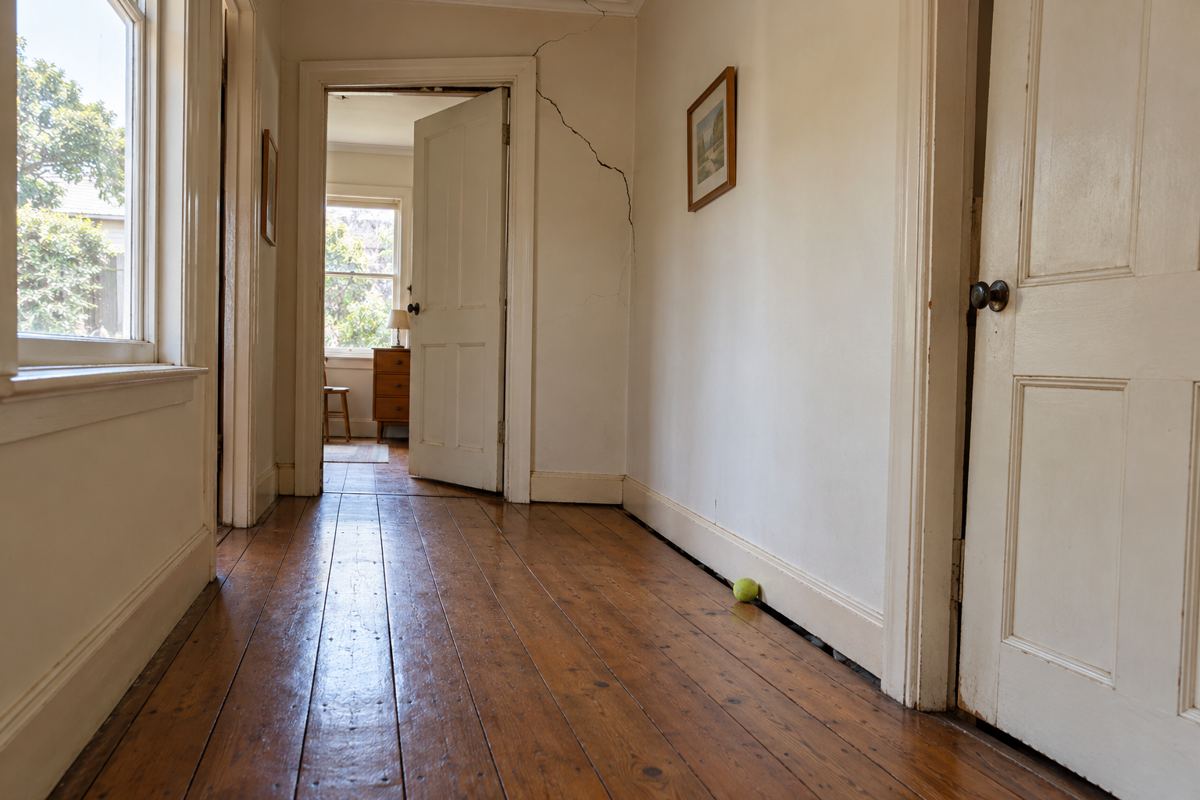
- A door that has started to stick or swing. A bedroom door that latched cleanly last summer now catches at the top corner, or swings closed on its own because the frame has leaned. The frame has gone out of square because the floor under one side has dropped.
- A floor that slopes to one side of the room. A tennis ball put down in the hallway rolls to the same wall every time. In a post-war holiday house the low end is often the wet side, under the bathroom and laundry, or the side where the garden beds sit against the base wall.
- Diagonal cracks from the corners of doors and windows. Plaster cracks running from the top corner of a door frame up toward the cornice. On clay ground they can open in late summer and close after the winter rain. Where a stump has rotted they open and stay open.
- A gap under the skirting board. The skirting is fixed to the wall and stays put while the floor drops away from it. Daylight or a dark line under a skirting means the floor has gone down, and the floor only goes down when what is under it has.
- A bouncy or dipped section between two firm points. If the floor gives underfoot in the middle of a room but is firm at the walls, that is usually a bearer or a joist that has rotted or been eaten, not a stump.
- Stepped cracks in brickwork outside. On a brick veneer on stumps, a stump under that corner has dropped. On a slab or strip footing, the footing has moved, and that is underpinning rather than restumping.
- Windows that no longer close square. Timber sashes that jam on one side, or aluminium sliders that have to be lifted to lock.
- A gap between the floor and the bottom of a wall lining. Easiest to see inside a wardrobe, behind the fridge, or under the kitchen kickboards where nobody has patched it.
What it looks like under the house
The signs inside say the house has moved. The subfloor says why. An hour under the floor with a torch, a probe, a long level and a moisture meter settles whether the job is a full restump, a handful of stumps, relevelling on sound stumps, bearers, or drainage.
| Under the house | What it usually means |
|---|---|
| Timber stump soft or hollow at the ground line when probed | Rot. The stump is replaced. On sand it rots where the stump meets the damp surface; on clay it rots where water sits. |
| Stump leaning, bearer no longer sitting square on it | The ground has moved, or the stump was never deep enough. On dune sand a stump can lean when the ground beside it has been dug or washed. |
| Tide marks on stumps at the same height | Water has pooled under the house in winter. Drainage before, or with, the stumps. |
| Mud tunnels up a stump, galleries in the timber | Termites. The whole Shire is designated subject to termite infestation. Pest controller first, then replacement. |
| Stack of timber, brick or tile packing between stump and bearer | The house has been relevelled before, cheaply. Packing that thick is a sign to probe the stump under it. |
| Bearer soft above a stump, floor dipped overhead | Rotted bearer. Replaced while the house is up on jacks. |
| Stumps and bearers sound, floor still out of level | Settlement. Relevel on the existing stumps, no digging. |
| Salt staining and a crumbling stump top | Salt air and damp on an older concrete or timber stump near the coast. Replace the worst, check the rest. |
| Brick piers cracked, strip footing showing | Footings moving. Underpinning on an engineer's design, not stumps. |
Why Peninsula houses show these signs
Four local reasons, and most houses have at least two of them.
A wet winter and a dry summer. The Bureau of Meteorology's Cerberus station averages 712.8 mm of rain a year over 105.5 rain days, with June the wettest month at 73.5 mm and February the driest at 34.8 mm. That is not a lot of rain by Victorian standards, but it arrives in winter and stops in summer. Clay swells when it is wet and shrinks when it dries, so a house on the clay country around Mount Eliza, Hastings or Somerville moves a little every year, and a cheap timber stump standing in winter water rots from the ground line down.
Sand that moves when disturbed. The southern Peninsula sits on dune sand. It drains fast, which is kind to timber, but it moves when it is dug, washed or when the cemented pan beneath it is cut. A stump that was set shallow in sand, or that has had a garden bed dug beside it, leans before it rots. The soils guide goes through each ground type.
Termites. Mornington Peninsula Shire has designated the entire Shire as subject to termite infestation under regulation 150 of the Building Regulations 2018. For an old timber stump that means the damage can be inside the stump while the outside looks fine, and the bearer above it can be going too.
Age and absence. The Shire's own thematic history describes post-war housing estates, holiday shacks and the urbanising of the Peninsula after the war. Those houses are now sixty to eighty years old, and many of them are visited a few weekends a year. The 2021 census counted 24,525 of the Shire's 93,502 private dwellings unoccupied on census night, 27.5 per cent, and a house nobody lives in can drop a corner over two winters without anyone noticing a door.
The first visit after winter
If you own a holiday house, the signs usually get noticed on the first long weekend after the wet months. Walk the hallway before the bags go down. Open every door and note which ones catch. Look along the skirting in the lowest room. Then go outside and look at the base of the house: a weatherboard that has bowed outward at the bottom, a brick pier with a crack, a stump visible through a vent that is leaning or dark with damp. If the house has a lockable subfloor hatch, a torch through it is worth five minutes. A neighbour who is there all year, or the agent who manages the place, is often the person who first says the back step has dropped.
Two things are worth doing before you leave again. Take photos: the lowest room from the doorway, the worst crack with a coin beside it for scale, the base of the house on each side, and anything you can see through the hatch. Photos from one visit against the next are a better record of movement than memory. And open the vents. A holiday house that has been shut for months with the vents blocked by leaf litter or a garden bed is a damp house, and damp is what rots stumps and brings termites. If the floor has dropped since your last visit, or a crack has opened that was not there in autumn, that is the point to ring rather than wait for the next long weekend.
What an inspector looks for
A pre-purchase building inspector will probe stumps at the ground line, note heavy packing, look for moisture staining, tide marks and fungus, and check the bearers at the wet-area corner. A pest inspector follows termite tunnels up the stumps and taps the bearers. Either report can name the stumps without counting them, which is why the buying guide says what to do with a report before settlement, and the cost guide says what a quote should name after the restumper's own inspection.
The restumper's inspection is different from the building inspector's in one way that matters: it counts. Every stump is probed, every bearer is sighted along its length, and the ground at the base of each stump is noted as sand, clay or fill. The result is a number of stumps to replace, a view on the timber above them, and a recommendation on stump type, which on salt-air sand near the coast and winter-wet clay inland is rarely timber. That inspection is also where the holiday-house questions get asked: where the key is, whether the vents have been blocked, and whether the garden has been built up against the base wall since the last owner.
What these signs cannot tell you
They cannot tell you how many stumps have gone, and the count is what the price depends on. They cannot tell you whether the bearers and joists above the stumps are sound, which on a damp Peninsula subfloor is the biggest unknown. They cannot separate, from inside, a dropped stump from a dropped footing under a brick veneer. And they cannot tell you whether the cause is still active: a shower that has been leaking into the subfloor for years, or a garden bed built up against the base wall, will rot the new timber as happily as the old. All of that is the inspection, with a torch, under the house.
Check the current rules before you rely on this
This page describes how subfloor problems show up in homes on the Mornington Peninsula and what they usually mean. It describes the rules in general terms as they stood in October 2026. Standards, forms, thresholds and fines change.
The authoritative sources are Airtasker guide to house restumping, Bureau of Meteorology climate statistics, Cerberus, Mornington Peninsula Shire, termite management and maintenance, ABS 2021 Census QuickStats, Mornington Peninsula (S) and Mornington Peninsula Shire thematic history 2013. Where anything here differs from those sources, they are right and we are not.
We are not building surveyors, engineers, planners or lawyers. For what applies to your house, ask a registered building surveyor or ring Mornington Peninsula Shire on 1300 850 600.
Accurate at the time of writing, October 2026. Always check the source before relying on it.